Should you clean old coins before selling or an appraisal?
No. Do not wipe, dip, polish, or soak an old coin before it is identified, appraised, or sold. Cleaning permanently changes the original surface that graders and buyers examine, and a grading company can label a cleaned coin as a problem coin instead of giving it a numeric grade. Leave it as found and decide from evidence.
In practice: photograph it as found, record the denomination, date, mintmark (or none), and visible wear from the coin itself, keep it with the group it came from, and look for three matched sold results—or write “no market evidence yet.” Then pick one reversible next step.
Pick one readable coin. Hold it by the edges over a soft towel, photograph both faces and the edge as found, and write down what you can read and what you cannot. Put it back in the holder, envelope, or album slot it came from.
- 10 of 20 pages that rank for coin-cleaning and inherited-coin searches put a percentage or money figure on what cleaning costs a coin; 1 of those 10 says how its figure was derived.
- 1 of 20 of those pages tells readers to check sold listings. In 250 public Reddit threads from heirs, the top replies pointed to sold listings or auction records in 22 of 250 (8.8%).
- Cleaning came up in 30 of those 250 heirs’ threads (12%).
Collected: October 8, 2026. Pages were fetched that day; threads were posted October 2025 to October 2026 in r/coins, r/coincollecting, and r/Numismatics.
Method: each page and thread was coded by SellingCollectibles against a pre-registered scheme; one coder.
Limit: one coder, a search list that approximates Google rather than live Google results, and subreddits that lean toward collectors.
Leave the surface as found
The urge is understandable: wipe it so the date “pops.” But a coin’s original surface is part of what a specialist or buyer is looking at, and cleaning changes it permanently. NGC, a coin grading company, explains that harsh chemicals or abrasives smooth the surface texture that produces natural luster, that cleaning leaves telltale signs, and that there is no legitimate way to restore natural surfaces once they are gone. Read NGC’s explanation of why cleaned coins can’t be uncleaned.
The U.S. Mint likewise cautions that polishing or cleaning coins can reduce their value and that older coins with deep age coloration are more desirable than coins whose surfaces were stripped by improper cleaning. See the U.S. Mint’s coin-care guidance. The Royal Canadian Mint goes further: unless you are an experienced specialist, avoid cleaning, because even wiping with a soft cloth may damage a coin’s finish. See the Royal Canadian Mint’s coin-care guidance.
| Tempting move | Why pause | Reversible first step |
|---|---|---|
| Wipe with a cloth, shirt, or jewelry cloth | Rubbing can leave fine lines and change how the surface reflects light. | Photograph as found under angled light; read the date with magnification instead. |
| Dip, vinegar, baking soda, or a household cleaner | Chemical cleaning can strip toning and original surface, and the change cannot be undone. | Record the color and any spots or deposits as observations, not problems to fix. |
| Polish, brush, or tumble | Abrasion removes metal and leaves marks a specialist will see. | Leave it alone and ask a specialist whether any conservation is appropriate. |
| Pop coins out of original mint or proof packaging, folders, or holders | Original packaging, labels, and certificates can matter, and handling adds fingerprints. | Photograph the package, labels, and any certificate together; keep them together. |
| Toss envelopes, notes, or rolls | The collector’s notes or labels may record origin, date, or what a group was meant to be. | Keep each note with the coins it describes and give the group a short name. |
Already cleaned? How to tell, and what it means
Many inherited coins were cleaned long ago, often with good intentions. You do not need to diagnose it with certainty, but you should note it, because it changes which sales are comparable. The American Numismatic Association’s Reading Room describes three common kinds of cleaning—abrasive cleaning, dipping, and polishing—and the signs each leaves. Read the ANA’s guide to recognizing cleaned coins.
- Unnatural shine for its age. A dipped old coin can look oddly bright, with bare metal where you would expect age; polishing leaves a glassy, uniform shine and rounded lettering.
- Fine hairlines under angled light. Rubbing, even with a “soft” cloth or tissue, can leave fine hairline scratches that show when you tilt the coin under a single light. Look with magnification; do not rub it to check.
- Color that doesn’t match in the recesses. Bright fields next to a toned rim, or grime still trapped around the lettering and design, are red flags, because those areas are hard to reach when a coin is cleaned.
None of these signs is conclusive on its own. Write “appears cleaned?” as an observation in your notes and let a specialist confirm it.
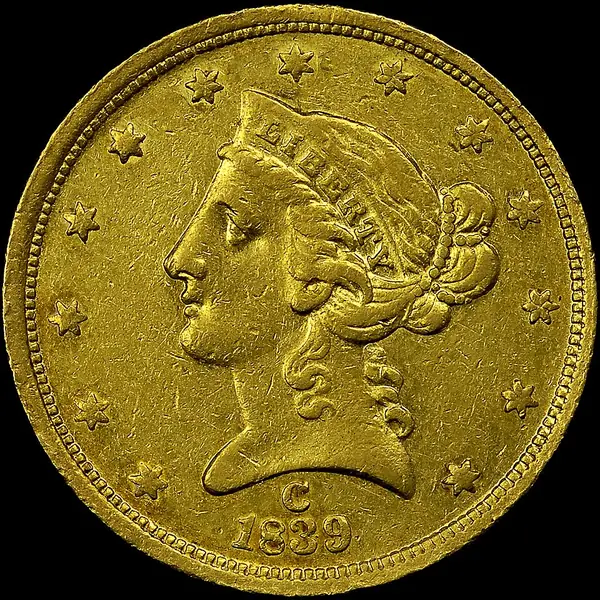
An 1839-C gold half eagle catalogued as NGC Details, “Improperly Cleaned.” The fine abrasions across the open fields are the kind of marks to look for under angled light. The small “C” above the date is the mint mark.
Photo: Eric P. Newman Collection, via Newman Numismatic Portal and Wikimedia Commons. License: CC0 1.0 (public domain dedication). Resized and compressed.

What “Details – Improperly Cleaned” means
NGC explains that coins that have been improperly cleaned cannot receive its numeric grade from 1 to 70. Instead they can receive an NGC Details grade: a word grade based on wear, with the surface problem—such as “Improperly Cleaned,” “Polished,” or “Wiped”—noted on the label. NGC adds that light, non-destructive cleaning on older coins may still permit a numeric grade, that harsher cleaning is not correctable with conservation, and that a Details coin’s value is never determined by its grade alone. See NGC’s Details grading explanation.
If it was cleaned: compare like with like
Do not try to fix it—no second cleaning and no attempt to “tone it back.” Record it as cleaned (or possibly cleaned). When you look for sold results, compare it only with cleaned or Details-graded sold examples of the same date and mintmark. An original-surface sale is not a match for a cleaned coin, and an original-surface catalog value is not its price.
Dirt, toning, or green spots: a specialist, not a cloth
Not everything on a coin’s surface is the same problem, and none of it is a kitchen job.
- Toning. Darkening or color on old silver and copper is part of the coin’s surface. The U.S. Mint says older coins with deep age coloration are more desirable than coins stripped by improper cleaning, and PCGS says its own restoration service will not remove original toning simply to make a coin white. Leave toning alone.
- Loose dirt or grime. Record it and read what you can under light and magnification. If dirt truly hides the date, that is a question for a specialist, who should see the coin as found.
- Green haze, spots, or sticky film. NGC explains that soft plastic flips containing PVC can leave a residue that starts as a pale green haze and can become green spots or a shiny green layer, and that this residue keeps corroding the surface—which is why NGC will not certify a coin with active PVC residue. Green on copper can also be corrosion. Photograph it, note which holder it came from, and ask about professional conservation instead of scrubbing.
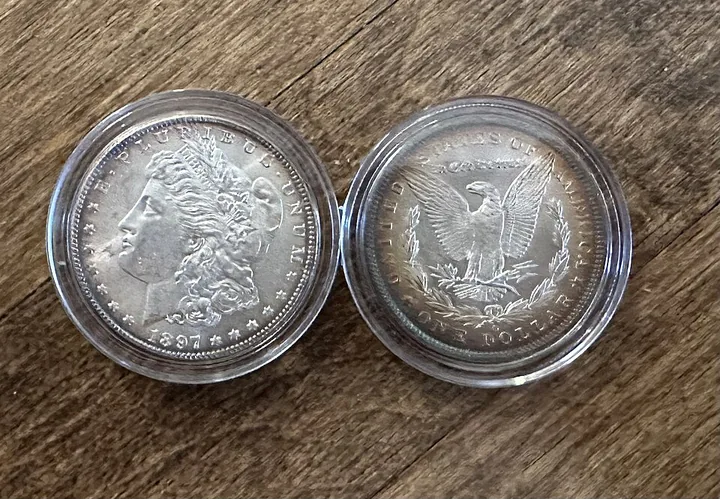
Toning is color on the surface of old silver or copper. It is not dirt to remove. These silver dollars are also stored the safer way: in hard, clear capsules.
Photo: Bruxton, via Wikimedia Commons. License: CC BY-SA 4.0 (photo); U.S. coin designs are public domain. Resized and compressed; this adapted image is shared under the same license.

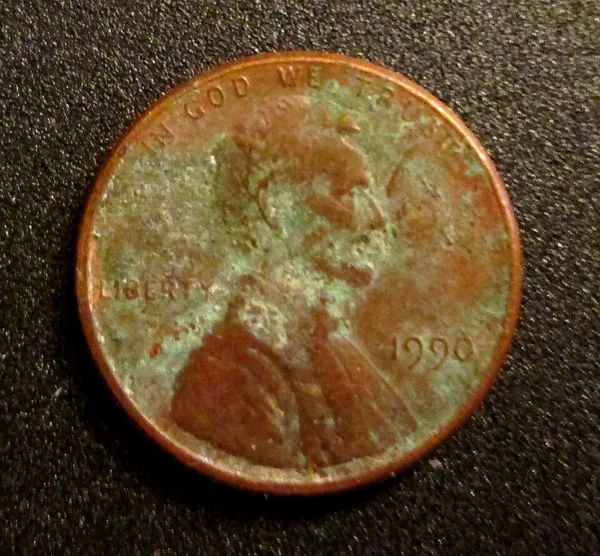
Green deposits like these are a question for a conservation specialist, not a cloth. Scrubbing can take the surface underneath with them.
Photo: Beyond My Ken, via Wikimedia Commons. License: CC BY-SA 3.0 (also available under the GFDL). Resized and compressed; this adapted image is shared under the same license.

Professional conservation is a separate service from cleaning. NGC says its affiliate, NCS, can remove PVC residue (NGC on treating PVC residue). PCGS Restoration addresses contaminants from improper care or storage, such as PVC and verdigris, evaluates each coin first, and states that it will never add, remove, or alter metal (PCGS Restoration). Not every coin qualifies, and a specialist can tell you whether yours is a candidate.
What about the U.S. Mint’s “mild soap and water” line?
The U.S. Mint’s coin-care page cautions that polishing or cleaning coins can reduce their value, then adds that if you do polish a coin to remove dirt, you should use mild soap and water, pat it dry with a soft towel, and avoid brushing or rubbing. That is general care advice for someone who already knows what the coin is. For an inherited coin, we still say leave it alone until it is identified: you do not yet know whether its original surface matters, washing cannot be undone, and the date, mintmark, and wear you need for the next decision can be read with light and magnification instead.
Identify the coin from the coin itself
Write down only what the metal shows: denomination, date, mintmark or no visible mintmark, and wear (for example, “design high points flat,” “date fully readable,” “hole near top,” “mounted in a bezel”). If the date is worn flat or a mintmark is unclear, write “unclear” rather than guessing. Do not assign a grade; grading is a specialist judgment.
Where to look for the mint mark
A mint mark is a small letter showing where a coin was made—for example S (San Francisco), D (Denver, or Dahlonega on early gold), P (Philadelphia), W (West Point), O (New Orleans), CC (Carson City), or C (Charlotte). The U.S. Mint explains that many coins struck at Philadelphia carry no mint mark at all, that circulating coins dated 1965 through 1967 had none, and that when mint marks returned in 1968 they were placed on the obverse (the front) after previously appearing on the reverse. Placement still varies by series, so check both sides under good light and write “no visible mint mark” if you cannot find one. See the U.S. Mint’s mint-mark guide.
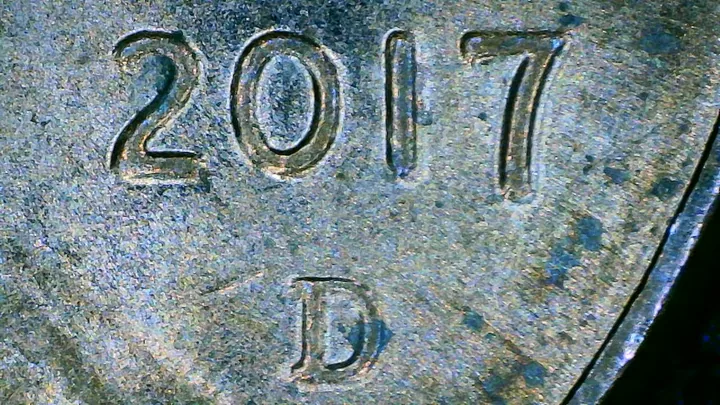
The “D” under the date on this cent is a Denver mint mark. The coin is corroded, but the date and mint mark can still be read under light and magnification without cleaning.
Photo: Roll 3d6, via Wikimedia Commons. License: CC BY-SA 4.0. Resized and compressed; this adapted image is shared under the same license.

A silver flag for older dimes, quarters, and half dollars
For the U.S. dimes, quarters, and half dollars of the 1900s that fill most family albums and jars, a date of 1964 or earlier means a coin struck in 90% silver. The Coinage Act of 1965 authorized copper-nickel clad dimes and quarters and a reduced-silver half dollar, and it required that any 90% silver coins struck after the law took effect still carry the 1964 date (Coinage Act of 1965, Public Law 89-81; U.S. Mint history timeline). Treat this as a sorting flag, not a price: note “silver, 1964 or earlier” and keep the coin in its group, but do not quote a metal value for a coin that may also have collector interest.
Graded holders: do not crack them open
If a coin is sealed in a grading company’s plastic holder (often called a slab), leave it sealed. The label carries a certification number; enter it in the grading company’s own verification tool to confirm the description and grade on record. NGC and PCGS both explain how (NGC on verifying certification; PCGS on certification verification). If the record does not match the coin and label, note that and ask a specialist.
A catalog reference such as NGC Coin Explorer can help you confirm a coin type and which dates and mints exist. Treat any guide or catalog value there as background, not as a sale of your coin.
Catalog values usually describe a specific grade with original surfaces. A cleaned, holed, or heavily worn coin is not that coin. Do not borrow a number for a grade you hope it has.
Group the collection, do not price it
Inherited coins usually arrive as albums, folders, rolls, bags, original mint or proof sets, holders, and a jar or tray of loose coins. Record each group—what it is, roughly how many, how it is organized, and what labels or notes come with it—before researching any single coin. The three-pass, group-first method applies here too.
- Photograph each album, folder, set, or container as found.
- Give each group a short name and keep its labels, notes, and certificates with it.
- Set aside one readable coin to research first; leave the rest in their groups.
Leave mint and proof sets sealed. The U.S. Mint says modern coin sets and coins should be bought and sold in their original cases and capsules.
Find three matched solds—or write “no market evidence yet”
For the one coin you set aside, look for completed sales—not asking prices—of the same denomination, date, and mintmark, in similar wear, with similar original or uncleaned surfaces. Drop cleaned examples if yours is original; if yours appears cleaned, keep only cleaned or Details-graded examples. Drop mixed lots, and drop anything you cannot match on date and mint. eBay’s seller help explains how to search completed listings through Advanced Search. Review eBay’s pricing guidance.
If you find three matched results, record them with their dates and why each one matches. If you cannot find three, write “no market evidence yet” and stop. Do not fill the gap with a catalog number, an asking price, or a similar-looking coin. That gap is useful information for the next decision.
Choose one reversible next step
The whole collection does not need one answer, and this coin does not need to be sold. Reversible next steps include:
- Keep and protect: return it to its original holder, or use an acid-free, PVC-free holder labeled with its group, and store it cool and dry.
- Family review: mark it for family discussion before any sale, gift, or donation.
- Specialist look, as found: show it uncleaned to a coin specialist and ask whether they are giving a purchase offer, consignment terms, an auction estimate, or an appraisal. If grading comes up, ask whether it would change the route before paying for it.
- Compare routes: if matched solds exist and selling is the goal, use the four-route comparison to weigh a dealer, auction, consignment, or estate sale for this coin or its group.
Whatever you choose, it should be one coin or one group—not the whole tray at once—and it should not involve cleaning first.
When replies in heirs’ threads warned about selling, the warnings were about pawn or jewelry counters, offers below metal value, and strangers offering to buy by message (see our data).
SellingCollectibles does not buy coins or make offers.
Common questions
Should I clean an inherited coin so the date is easier to read?
No. Photograph it as found and read the date under good light and magnification instead. Wiping, dipping, polishing, or brushing can permanently change a coin’s original surface, and that change cannot be reversed.
Can I clean old coins with vinegar or baking soda?
No. Vinegar, baking soda, toothpaste, and jewelry dips work by stripping or scouring the surface, which removes original metal and toning and can leave fine scratches. Grading companies identify chemically or mechanically cleaned coins, and the change cannot be reversed. Read the date with light and magnification instead.
Does cleaning coins decrease their value?
For any coin with collector interest, it usually does. Buyers and graders look at the original surface, NGC will not give an improperly cleaned coin a numeric grade, and harsh cleaning cannot be corrected with conservation. How much it matters depends on the coin and the cleaning, so we do not put a number on it.
How can I tell if a coin has already been cleaned?
Tilt it under a single light and look with magnification for fine hairline scratches, an unnaturally bright or glassy shine for its age, and bright fields next to a toned rim or grime left around the lettering. No single sign is conclusive, so note “appears cleaned?” and let a specialist confirm.
What should I do about green spots or sticky green residue?
Do not scrub it. Photograph the coin in the holder it came in and ask a professional conservation service whether it can be treated. Green residue can come from PVC in soft plastic flips and can keep damaging the surface, so do not leave it unattended indefinitely.
Do I need to look up every coin in an inherited collection?
No. Record albums, folders, rolls, original mint or proof packaging, holders, and loose groups first. Research one readable coin at a time, and only when its identity or a specialist question could change the next decision.
What counts as a comparable sale for a coin?
A completed sale of the same denomination, date, and mintmark in similar wear and with similar original or uncleaned surfaces. Asking prices, catalog or guide values, cleaned examples, and mixed lots are not matched sales. If you cannot find three, record “no market evidence yet” instead of filling the gap with a guess.
Should I get inherited coins graded before selling?
Not as a first step. Identify the coin, keep its group together, and look for matched sold results first. Then ask a specialist whether grading would change the route for that particular coin, and check the grading company’s current fees on its own website before sending anything.
Should I open mint sets or proof sets?
No. Keep sets in their original packaging with any certificate or information card. The U.S. Mint says modern coin sets and coins should be bought and sold in their original cases and capsules, and opening a set cannot be undone.
How should I store an inherited coin while I decide?
Keep it in its original holder or packaging if it has one. Otherwise, handle it by the edges and use an acid-free, PVC-free holder, labeled with the group it came from, and keep it cool and dry.
SellingCollectibles built this guide from the NGC, American Numismatic Association, PCGS, U.S. Mint, Royal Canadian Mint, Congress.gov, and eBay pages linked above; sources checked October 8, 2026. The “Our data” counts come from SellingCollectibles’ inherited-coins advice study, collected October 8, 2026. Images are from Wikimedia Commons and are credited under each image. The publisher is responsible for it under the editorial standard. It is a preservation and decision workflow, not an appraisal, authentication, grade, conservation plan, purchase offer, or claim that any coin has market value.
The private inventory stays in your browser and lets you record each group’s rough quantity, organization, photographs, provenance, disposition, and risk. It does not identify coins, assign grades, estimate prices, or transmit the collection.